
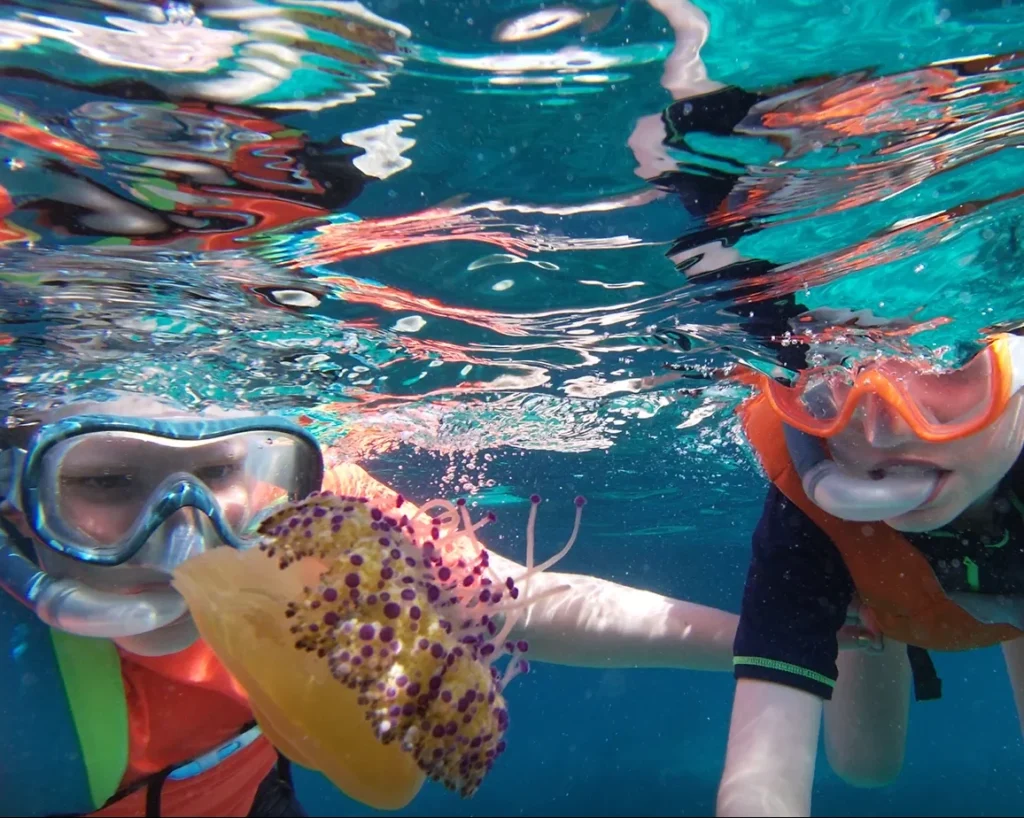
Every summer, millions of families travel to the Mediterranean, attracted by the beauty of its coastline, its crystal-clear waters and the promise of wonderful moments together. Yet one of the most surprising observations we have made over the years at Meet the Sea is how many visitors spend almost their entire holiday in a swimming pool, barely venturing into the extraordinary natural environment that surrounds them.
For many children, and indeed many adults, the swimming pool represents familiarity, comfort and security. The sea, on the other hand, presents a world of uncertainties. What lies beneath the surface? How deep is the water? What happens if a fish comes close? What are those strange plants brushing against our legs?
These are questions and concerns we encounter regularly aboard our boat in Ibiza. They have helped shape our understanding of the relationship that many people have with the sea and, ultimately, the experiences we have developed at Meet the Sea. Helping families make the transition from swimming pool to sea has become one of the most meaningful aspects of our work at Meet the Sea.
Discovering an unfamiliar world
One of the most fascinating aspects of our work is observing how little many of our visitors know about the marine environment.
The Mediterranean is home to an extraordinary diversity of life, yet many of its most common inhabitants remain completely unfamiliar to the people who holiday beside it.
A sea urchin can inspire fear. A sea cucumber may provoke expressions of disbelief. The sight of a dark underwater meadow can make even confident swimmers uncomfortable.
But introduce these creatures, explain how they live and reveal some of their remarkable characteristics, and something begins to change.
At Meet the Sea, our marine-life presentations are designed to awaken curiosity before our visitors even enter the water. Children discover the colourful fish that inhabit our coastline, the fascinating characteristics of marine invertebrates and the extraordinary importance of Posidonia oceanica, the Mediterranean seagrass whose meadows sustain so much of the life beneath the surface.
By the time we begin our guided snorkelling experience, the underwater world is no longer quite so unfamiliar. There are creatures to find, species to recognise and discoveries to share.
From swimming pool to sea: when fear becomes curiosity
Perhaps the most rewarding moments of our Family Boat Trips are those in which we witness a child’s initial apprehension gradually give way to excitement.
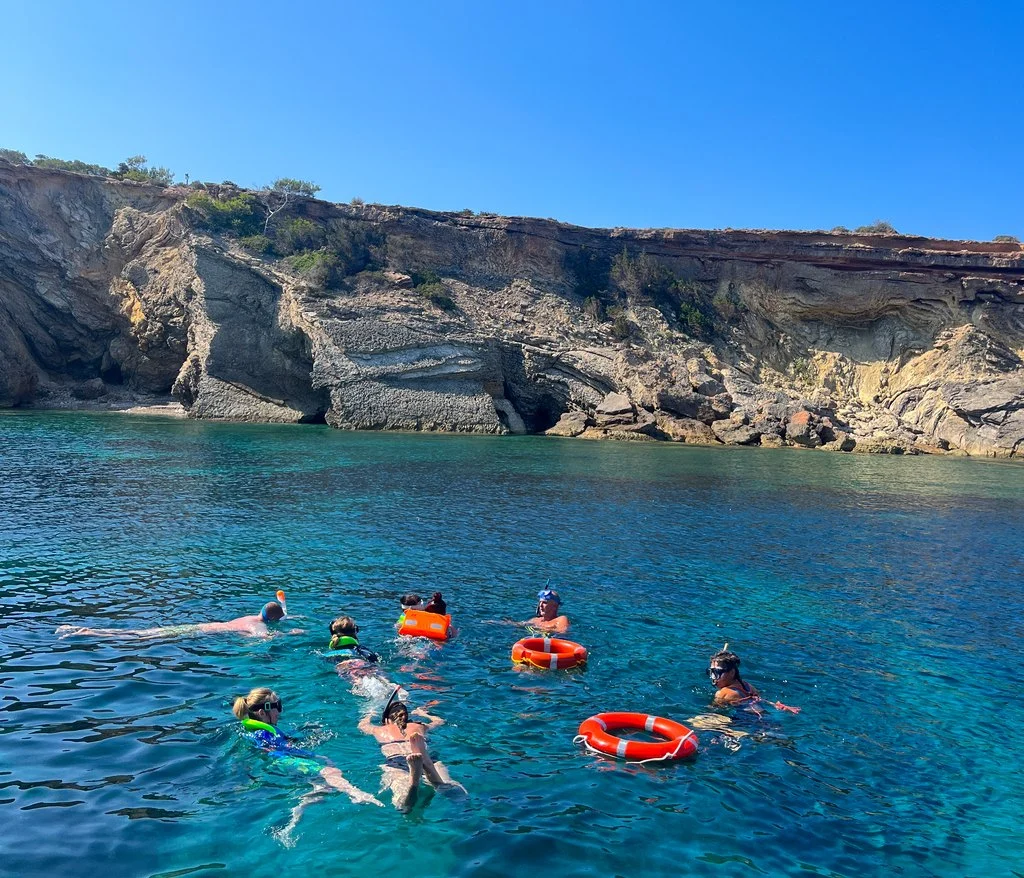
A child who is reluctant to leave the boat may begin by simply looking beneath the surface. With encouragement, suitable flotation equipment and the guidance of our team, that first glimpse can lead to the discovery of a fish they recognise from our presentation. Suddenly, there is a reason to keep looking.
The attention that was previously focused on the depth of the water or the fear of encountering something unfamiliar begins to shift towards the fascinating world unfolding beneath them.
Every child follows a different journey. Some enter the sea immediately, while others need time and reassurance. We respect that individuality, allowing each participant to discover the marine environment at their own pace.
What makes these moments so special is that the discovery extends beyond marine life.
Children discover something about themselves. They realise that they are capable of doing something they previously thought they could not do. They develop confidence, a greater sense of independence and pride in their own achievements. And they are having fun.
The joy of discovering together
We often speak about the educational value of our experiences, but there is another dimension that has become increasingly important to us: the emotional value of shared discovery.
Watching parents and children explore the underwater world together is a wonderful reminder of what family holidays can offer.
In the sea, parents and children become fellow explorers. A child may be the first to recognise a species, enthusiastically pointing it out to their parents. Families share the excitement of encountering marine creatures in their natural habitat, observing them freely going about their lives.
Some of the most moving reactions we receive at the end of our trips come from parents who have witnessed a change in their children.They have seen them overcome a fear, develop a new interest or accomplish something unexpected. They have shared that moment with them.
These are experiences that cannot easily be replicated in a swimming pool, however beautiful the hotel or however enjoyable the surroundings. They are moments of genuine connection with nature and with one another.
Education without the classroom
At Meet the Sea, we believe that education and enjoyment should complement one another.
Children have an extraordinary ability to recognise when adults are trying to turn their holidays into a lesson. Our objective is quite the opposite: to create an adventure so engaging that learning becomes a natural consequence of the experience.
We want children to be the stars of our trips, actively participating in their own discoveries rather than simply observing what adults show them. Recognising a rainbow wrasse, discovering the camouflage of a marine creature or understanding why a seagrass meadow is so important becomes part of the excitement of exploring the sea.
Knowledge acquired through curiosity, emotion and personal experience can take on a significance that goes far beyond the memorisation of facts. This is the philosophy that guides our Family Boat Trips and that we continue to develop through our School Sea Trips, bringing young people into direct contact with the Mediterranean and its remarkable biodiversity.
From appreciation to protection
Our oceans face enormous environmental challenges. Rising temperatures, pollution, habitat degradation and the pressures of human activity are affecting marine ecosystems across the world.
The Mediterranean is particularly vulnerable, and protecting its biodiversity requires scientific research, effective environmental policies and responsible behaviour from all of us who enjoy and depend upon it.
At Meet the Sea, we believe that marine education has an important contribution to make to these efforts.
When children discover that a meadow of Posidonia oceanica is not simply a collection of underwater plants but a living ecosystem providing shelter for countless species, their perception of it changes.When they learn about the creatures inhabiting our waters and have the opportunity to observe them in their natural environment, the sea becomes something more than a beautiful backdrop to their holidays.
It becomes a world they know a little better, appreciate a little more and may feel increasingly motivated to protect.
Our partnership with Ibiza & Formentera Preservation reflects our commitment to supporting the conservation of the natural environment in which we carry out our activities. We believe that businesses operating at sea have a responsibility not only to respect marine ecosystems but also to contribute actively to their preservation.
Education is one of the ways in which we can make that contribution.
A different kind of holiday memory
Since the creation of Meet the Sea, we have been driven by a simple conviction: time spent at sea can change the way we think, the way we feel and the way we connect with the world around us.
We want our visitors to return home with wonderful memories of their time in Ibiza. But we also hope they take something else with them: a greater confidence in the sea, a deeper appreciation of its inhabitants and a renewed curiosity about the natural world. The journey from swimming pool to sea represents much more than a change of surroundings. It can mark the beginning of an entirely different relationship with the natural world.
Perhaps, on their next holiday, they will spend a little less time beside the swimming pool and a little more time discovering what lies beneath the surface of the sea. Perhaps a child will recognise a fish they first encountered with us, explain the importance of seagrass to a friend or inspire their family to explore another coastline.
These seemingly small changes matter,because the relationship we develop with the sea today can influence the way we care for it tomorrow. And that, ultimately, is why we do what we do at Meet the Sea.